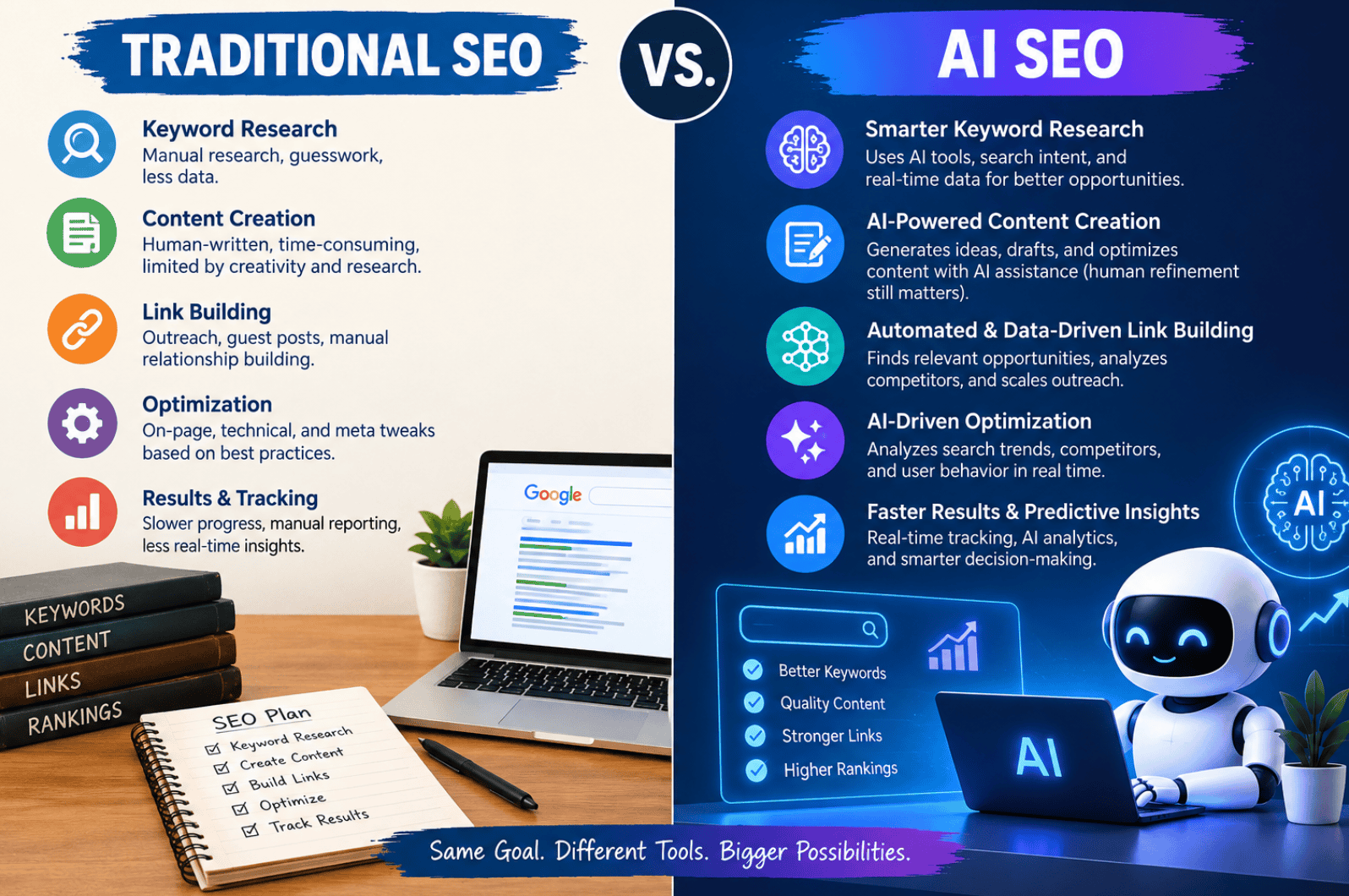
TRADITIONAL SEO VS. AI SEO: WHAT MARKETERS NEED TO UNDERSTAND
Search is evolving faster. What once worked for generating organic traffic 5 years ago is giving diminishing returns. And it’s not just because people are competing harder or the algorithms are changing so much.
It’s because how search engines understand, evaluate, and display content is changing. AI SEO and traditional SEO are basically the same field but with a different name.
Read on to learn more!
Table of Contents
What is Traditional SEO Based on?
The basic rules of traditional SEO were pretty straightforward:
- Find keywords that have high search volume
- Develop keyword-rich content
- Acquire backlinks from high domain authority sites
- Allow site rankings to come in.
This strategy yielded results because most search engines were pattern-matching engines:
- They sought text that signaled relevance and authority
- They rewarded content that was clearly relevant and authoritative.
The results were predictable.
How AI has Changed Search Fundamentally
AI-driven search engines don’t just look for keywords in the query. They try to:
- Grasp the purpose of the search
- Assess the depth and credibility of the information being presented
- Gauge the actual usefulness of the material.
This means, if content is geared towards keywords and doesn’t offer any real expertise or clear answers to the questions users are seeking, it will become increasingly underperforming compared to content that has proven subject matter authority.
Understanding the true requirements of AI SEO
AI SEO doesn’t fundamentally alter the core principles of optimization (which remain important). But it does elevate the quality of the content itself.
Content should be:
- Organized so that language models can easily identify and assign answers to it.
- It must be specific rather than general.
- It should address the entire topic and not a specific keyword variation.
- Create it regularly enough to establish topical authority.
When it comes to AI search visibility, the two most important factors are topical depth and content consistency. Not the sheer number of pieces created.
This also changes how you should approach your marketing workflow. Rather than treating SEO, content planning, and performance tracking as separate activities, custom-trained AI marketing software brings these functions into a more connected process.
The Technical Foundation Still Matters
This move toward AI SEO is interpreted as an “seo shift.” However, it would be a blunder to assume that technical optimization is no longer relevant. That is:
- Page speed
- Mobile usability
- Structured data markup
- Crawlability
- Internal linking architecture.
These elements are still relevant as they influence the ability of search engines to efficiently access and index the content being generated. The only thing that has changed is that it is no longer enough to have technical health. It is now the minimum requirement.
You need a technically sound site with solid, authoritative content.
Last Thoughts
AI SEO is a development of traditional SEO. Technical principles are still important. But signals that decide AI visibility prioritize real expertise and topical depth above keyword optimization alone.
With such changes, marketers who recognize this difference and modify their content strategy appropriately will be in a better position.

Biswajit Rakshit is a professional blogger and writer. He loves to write on various topics.