The Post-Incident Blueprint: How to Debrief and Support Staff After a Confrontation?
There is a correct way to debrief and support an employee who has just been involved in a confrontation. This will help the employee to quickly move on from the emotional effect of a stressful incident, making them and their coworkers feel safer. We will cover the steps you need to follow to do this effectively.
Table of Contents
Two Debriefs, Not One
The most common mistake supervisors make is believing the debrief is a single process they can do whenever there’s time. There are two.
The first is the hot debrief, within minutes of the incident ending. Its only job is ensuring physical safety: Is anyone hurt? Is the aggressor no longer present or contained? Does anyone need a few minutes to calm down before being asked what happened? This is not the time for analysis. That comes second. This is psychological first aid: the priority – the only priority – is safety, calm, and connection. Ask if anyone needs medical attention. Ask if anyone needs a few minutes away from the floor. That’s it.
The second is the cold debrief, 24-72 hours later when the adrenaline’s out of your system and you can think in full sentences again. This is when you’d pull out a list of what happened during the week, not while people are still shaking and the ink’s not yet dry on the police reports. Run the cold debrief too soon, before people have had a chance to process, and you’ll just re-traumatize them without producing usable institutional memory. Wait too long and details blur, or you lose staff with “it didn’t seem important anyway.”
Structuring The Formal Debrief
The cold debrief is most effective when it takes its structure from the after-action review model that the military and emergency responders use. There are four simple questions to guide your discussion: What did the plan assume would happen? What actually happened? Why was there a gap between the two? What are we going to do about it?
The beauty of this strategy for debriefing is that it keeps the conversation about what occurred, rather than how people feel about it or whom to blame. It’s not about “why did you let yourself get cornered like that?” It’s about “what did the plan expect you to do if corners were inevitable, and where did that expectation break down?” That’s a big distinction, and it works even better than you’d think at first. The way your question is perceived as blame versus genuine curiosity changes whether or not you get an honest answer.
Order of operations is important here as well. You can’t ask about the training gap that led to the incident if people are still processing the fact that they felt terrified when it happened. Check in with how people are feeling. Check in with what they were feeling when the confrontation went down. After everyone’s got everything off their chest, you start talking about what happened operationally and where the plan needs to change.
Turn Findings Into Training, Not Just Paperwork
A debrief that ends with a filed report and no action was a waste of everyone’s time. Every finding needs a next step, and for a large share of incidents, that next step is skills-based.
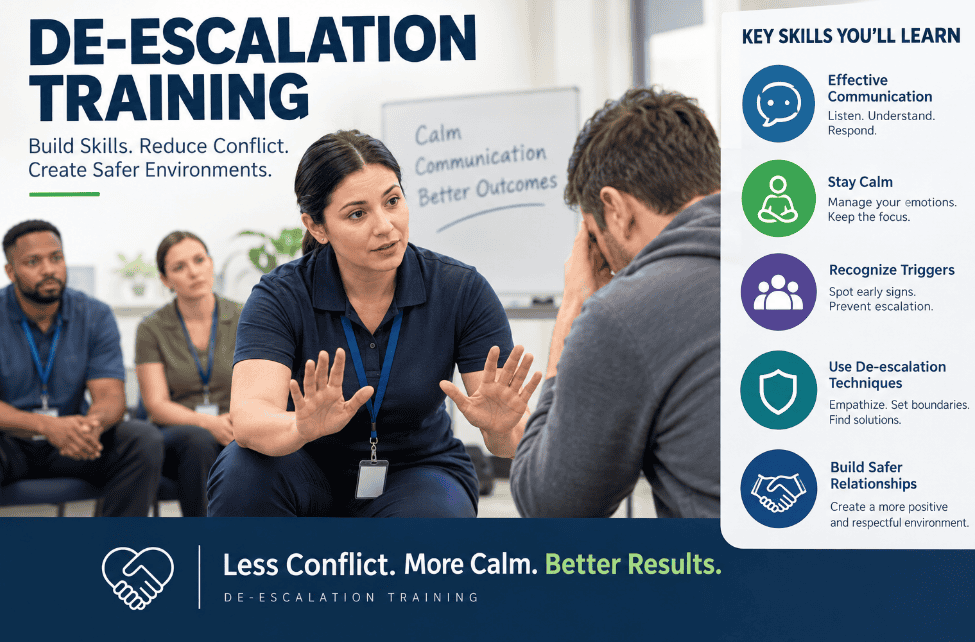
When a debrief reveals that staff lacked the confidence or skills to defuse a tense situation before it turned hostile, investing in structured de-escalation training is the most direct corrective action a facility can take. The de-escalation continuum – the range of verbal and non-verbal techniques that can interrupt a confrontation before it reaches a physical stage – is teachable, and staff who’ve practiced it recognize warning signs earlier and respond with more composure.
But don’t assume every gap is a training gap. Sometimes staff already have the skills and simply didn’t use them because policy discouraged intervention, or because they weren’t confident management would back their judgment call. If that’s what the debrief surfaces, more training won’t fix it. A policy conversation will.
Healthcare and social service workers account for roughly 73% of all nonfatal workplace violence injuries resulting in days away from work. That figure alone should settle any debate about whether this deserves a formal process or can be handled informally when someone gets around to it.
Ask Questions That Don’t Have A Predetermined Answer
A debrief run by someone with a theory they’re trying to confirm isn’t a debrief – it’s an interrogation with better branding. Open-ended, non-leading questions get you actual information. “What caught you off guard about this situation?” gets a different answer than “Didn’t you notice he was getting agitated before it escalated?” One invites reflection. The other invites defensiveness.
This is where psychological safety decides whether the debrief produces anything useful at all. If staff believe honesty will be held against them, they’ll tell you what they think you want to hear, and you’ll walk away with a debrief that confirms nothing was wrong and nobody needs anything different. That’s the outcome that guarantees the next incident plays out the same way.
Who Should Run The Room?
The direct supervisor is commonly the worst person to lead the debrief, even in their best efforts. Power dynamics are real, and an employee who evaluates someone’s performance every day isn’t going to get a candid account from that same person about what they felt or what they missed. A trained facilitator – someone without a stake in the employee’s next review – gets further.
This is how peer support programs prove their worth. A colleague trained in basic debrief facilitation can run the check-in with far less intimidation than a manager, and staff open up differently to someone who’s stood in the same position. Several organizations that have built out workplace violence prevention programs treat peer supporters as a standing resource, not a one-off assignment, precisely because the value compounds with repetition and trust.
Documenting Without Writing A Confession
Each debrief you have becomes a written record. More likely than not, you’ll rely on your notes if there are ever questions about that conversation in an insurance claim, a workers’ comp filing, or a legal proceeding. Keep notes as if you expect them to be reviewed in court or during a discovery process.
The same goes for your observations. Stick to what you saw, not what you think or feel. “The visitor raised his voice and stepped toward the employee” is a clear observation. “The employee failed to de-escalate the situation properly” is a vague assessment that could be read as an admission of liability on your part.
Before you ever find yourself making notes, check with HR or under any relevant union or insurance agreements on what kind of language you’ll need to use and what you’ll need to document. It’s a lot easier to have a policy in place before you’re in the middle of an emergency and things are confused.
The OSHA General Duty Clause requires employers to maintain a workplace free of recognized hazards, and that obligation extends to what happens after an incident. A debrief record that shows you identified a hazard and did nothing with the information is a liability. A record that shows the hazard was identified and addressed protects everyone.
Look For Patterns, Not Just Isolated Incidents
One argument is a happening. Three arguments in the waiting area in two months’ time are a risk. And the kind of risk that you really need to be careful about. So, gather the data about the location, the time of day, the day of the week, the level of staffing, and the provocation that led to the flare-up of each and every incident, not just the most recent one. Then, look for commonalities and see where problem areas lie. Was it understaffed Saturday night shifts? The layout that creates a chokepoint at the entrance? A policy that aggravates people before they ever get to the receptionist?
This is the step where you’ll have to fight your bias: the notion that it’s a certain employee’s attitude or demeanor that’s triggering people’s anger. It’s most likely a reflection of something in the environment: something physical about the space, or something metaphorical about your collective actions.
Individual Follow-Up, Not AOne-Time Meeting
A group debrief is helpful, but it’s not likely to be the last step for your staff who were directly involved. This is the point at which you coordinate one-on-one check-ins for anyone who wants one, ideally within a week. Acute stress reactions are a predictable response to abnormal events that present a danger of extreme harm or death. These reactions may include having a more difficult time falling or staying asleep, avoiding the very spot where the incident occurred, or noticing that you’re reacting a bit more than normal to loud noises or someone suddenly walking into the room.
These reactions are more likely to fade with time if they’re treated as the norm – that matters more than most managers will ever know. If you have access to an employee assistance program, make sure people know that it’s there, and that it’s a good step to take just to get their heads around what happened. More is rarely needed in the short term – but keep in mind that secondary trauma accumulates. If you’re sending in workers knowing that some will be threatened or harmed sooner or later, it’s likely compounding the long-term impact of each new event.
A single debrief can be a lot more effective if small, difficult experiences aren’t still sitting in the same drawer when the next big one comes along.
Repairing The Team, Not Just The Individual
A serious enough conflict in the workplace affects more than just those involved. It shakes anyone who saw or heard about it, and anyone who now has to wonder if work is a safe place. After an incident, invest time and effort in restorative practices – those deliberate things you do to repair trust and get the team functioning normally again. These should become part of your standard post-incident operating procedure, even for seemingly contained cases.
It could be as simple as a quick stand-up team check-in the next week, where you say “I know tensions were high last week, we’re all good now, right?” The absence of that assurance is a message too if it happens repeatedly, and one you don’t want to be sending. A decent debrief is an investment of an hour, two at most. The opportunity cost of not doing it is high – higher turnover, worse repeat incidents, and staff who’ve decided conflict isn’t worth reporting because nothing changes anyway.

Biswajit Rakshit is a professional blogger and writer. He loves to write on various topics.