How Can Smart Manufacturing Improve Productivity, Quality, and Operational Efficiency?
Manufacturing is increasingly becoming more connected, smarter, and more adaptive. The factories are stepping away from conventional practices and are incorporating digital solutions that will assist them in gaining an understanding of what is going on within their machines, production processes, raw materials, and workflow.
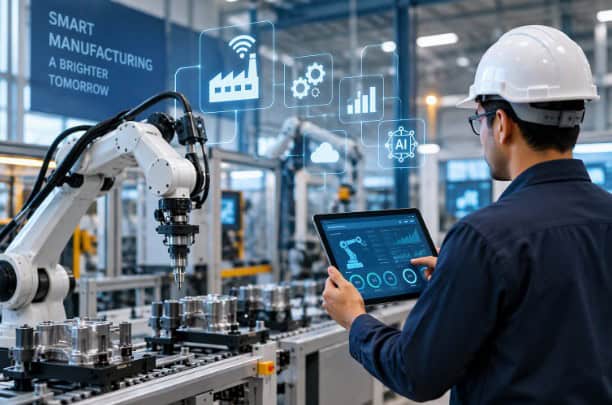
Smart manufacturing entails the integration of technological solutions like automation, artificial intelligence, robotics, sensor connectivity, cloud computing, and data analysis. However, smart manufacturing is not merely about integrating technology. It is all about facilitating sound decision making, eliminating inefficiencies, enhancing quality of products, and streamlining processes.
A Digital Manufacturing course will be useful for professionals seeking to comprehend this evolving scenario since it offers them relevant knowledge on inter-connected manufacturing systems and digital operations. In the same vein, an online Smart Manufacturing course will help students comprehend how intelligent technology can enhance productivity and efficiency.
Table of Contents
Improving Productivity Through Smarter Processes
Being productive does not necessarily mean working harder or faster. Being productive means using your resources, your time, your materials, and technology efficiently.
Within the traditional manufacturing setting, production crews can end up spending a lot of time examining machines, examining documentation, finding out what the constraints are and working with various departments. Information that is dispersed can mean that even simple production problems become difficult to comprehend.
Smart manufacturing facilitates a connected environment in which data transfer is seamless among machines, systems, and people. Employees have the ability to be aware of everything that is happening during the process of production, and they are able to react accordingly.
Smart manufacturing can support productivity by:
- Automation of repetitive activities in production and minimizing manual effort
- Supplying the workers with relevant information regarding the equipment and production situation
- Facilitating the identification of bottleneck processes in production management
- Coordinating the work of manufacturing, maintenance, quality, and supply departments
- Planning according to operational information available
The end result is a working environment in which the staff members can save time looking for information and use that time to find solutions.
Strengthening Product Quality
Quality is a major aspect in the field of manufacturing. Any slight difference in materials, machines, or process can have an effect on the finished product.
The conventional form of quality management largely relies on inspection carried out in various stages of manufacturing. Although inspections are still essential, smart manufacturing ensures that production conditions can be monitored continuously.
Sensors that are connected can be used to gather information regarding machinery performance, temperature, pressure, speed, and various other production-related details. Using analytics solutions, one could help teams recognize any oddities before they become bigger quality issues.
This converts quality management from a reactionary approach to a proactive one.
Smart manufacturing can help organizations:
- Ensure more consistent monitoring of manufacturing conditions
- Detect quality problems at an early stage of the production process
- Learn about the reasons for any defects in products
- Make production activities more consistent
- Ensure that quality teams have better information for making decisions
This strategy will also facilitate collaboration in the process. Rather than having quality be the responsibility of an individual unit alone, all those involved in the manufacturing process can collaborate using the same information.
Creating Greater Operational Efficiency
A manufacturing plant is composed of many processes that need to be coordinated. They include procurement, inventory, equipment, scheduling, maintenance, transportation, and manpower management.
When each one works independently, problems tend to occur. The materials may come at the wrong time, machines may not be available for the required period, or teams may find it difficult to revise their schedules as circumstances vary.
These activities are linked together through smart manufacturing, which links all the information about them. The manager is able to get clearer insight into production, equipment availability, material flow, and other requirements. It becomes easier for him to see what needs improvement and where.
Some important areas where smart manufacturing supports operational efficiency include:
- Equipment monitoring: Connected systems can provide information about machine conditions and help maintenance teams identify potential problems.
- Inventory visibility: Digital systems can improve visibility into materials and components moving through manufacturing operations.
- Production planning: Better access to operational information can help teams adjust schedules when demand or production conditions change.
- Resource utilization: Organizations can understand how machinery, materials, energy, and workforce resources are being used.
- Process improvement: Manufacturing data can reveal recurring delays or inefficient activities that might otherwise remain unnoticed.
In addition, it presents an opportunity for better collaboration between production and maintenance teams since both teams will have access to similar operational data.
Helping Employees Make Better Decisions
Technology plays a significant role in intelligent manufacturing, but humans still play an essential role.
Operators know production processes. Engineers know equipment and technologies. Quality departments know the standards. Managers know operations.
With smart manufacturing, these professionals gain access to superior information that helps them use their knowledge and experience better.
Those who enroll in the Digital Manufacturing course may gain more knowledge about the role of data, automation, digitalization, and connectivity within the context of manufacturing processes. Taking the Smart Manufacturing course will also enable professionals to learn how new technologies may be employed effectively within production and operations.
These capabilities become increasingly useful as manufacturing roles require professionals to work across both physical operations and digital systems.
Building a More Flexible Manufacturing Environment
Manufacturers constantly face changing demands from their customers, supply issues, availability of machinery, and other factors affecting production. A rigid process will make responding to change difficult.
Smart manufacturing increases transparency throughout operations and enables businesses to act faster. If production groups have access to valid data, then they are able to make necessary changes rather than making blind decisions.
Increased flexibility can aid organizations in coping with varying production needs while focusing on quality and control.
Conclusion
The era of smart manufacturing has brought about an evolution of the perception of productivity, quality, and efficiency in organizations. Smart manufacturing connects equipment, information, systems, and people, leading to improved visibility and control of manufacturing operations.
Automation will help cut back on repetitive activities, technology connectivity will provide equipment visibility, and data analysis will help with decision-making regarding production and quality processes. What is most important, however, is that technologies will provide workers with information that will enable them to address any problems with greater confidence.
In today’s age where digitalization is increasingly affecting manufacturing operations, individuals who possess knowledge on technology and manufacturing processes will find themselves better equipped in the face of an ever-changing industry landscape. Individuals can acquire knowledge through studying a Digital Manufacturing or Smart Manufacturing course to gain knowledge of how things operate in manufacturing today.
For more information, please visit our blog.

Sudarsan Chakraborty is a professional Blogger and blog writer. He lives and breathes in the blogging industry. He regularly writes on Widetopics to keep all the readers updated with the latest facts on wide range of topics.